Sunday, January 9, 2011

Strategy for Routine Requests in 3 Steps


Routine requests are no exception to business message etiquette. They should have an opening, body, and a close. In this instance it is best to use a direct approach, so your statements are clear, concise, and get to what you are asking. Routine requests can be used when asking for:


(Larry Barkdull Article)


In these cases it is best to open with the request, the body should give explanations to justify the request, and lastly the specific action should be asked for in the closing.

Step One: Putting the Request Front and Center

By putting the request up front, it receives more attention and is perceived as being most important. Although, getting to the point should not occur at the risk of sounding rude and hasty.

A.) Be careful with the tone of your request.
The tone of your request should be soft and show appreciation.Demanding a request may invoke an unfavorable response.
B.) Presume that your audience will agree to your request
If given good reason and justification you can assume your audience will comply with your request. As a result, an eager demand for a quick response is unnecessary.
C.) Give the details
Be sure to ask for exactly what it is that you want. The audience is more likely to fulfill your request if it’s easy for them to know exactly what to do.

Step Two: Lay Out Your Case

The body of message should enlighten the audience as to your request, and explain your purpose. Give all the information needed by avoid long unnecessary information. (Mario Medina Presentation) If applicable, it would be a good idea to show how the reader can benefit from your request. This part of the message should steam out from your opening remarks. It can also be a place to ask questions. These questions will not only organize the letter, but may also help the reader understand what you are asking for. Yet, a few things should be kept in mind when questioning.


A.) Important Questions come First
Questions about your main concern should come first. After that it would be able to ask questions that relate to the original questions.
B.) Applicable Questions Only
In order to make the best use of the audience’s time, ask only questions that relate to your specific request. This will help to get a quick answer.
C.) Make it Easy
Requests that have a lot of components should be broken down into separate questions. This way the reader can attend to each question individually. Not only will this help you get a more precise answer, but it will also show respect for the reader’s time.Also, by providing a framework for the letter it takes a lot of work out of responding which may lead to you getting a better response. (Larry Barkdull Article)
D.) Open-Ended
By asking open ended questions you’re likely to get more information than a simple yes or no question.(Mario Medina Presentation)

Step Three: Wrap it Up

The closing of your message is just as important as the opening and the body. In this close you should have the detailed request, your contact information, and a statement of appreciation and/or goodwill.

A.) Ask for the Action
Again restate your request, be specific. Also, if it is appropriate, give the reader a specific time you would like the response and explain why at that time.(Mario Medina Presentation)
B.) Contact Information
Give the audience all avenues of reaching you. This will make it easy for your reader to respond. Share with them your phone number, email address, your office, office hours, and any other information you have
C.) Appreciate
End the message with sincerely giving a word of goodwill and/or appreciation. Try to avoid the usual cliché endings, make it something new and audience oriented.(Mario Medina Presentation) Do not thank the reader in advance. Upon receiving the answer, if you feel it appropriate to thank them, send them a thank you but only after receiving the response.

References:
Excellence in Business Communication - Thill and Bovee, 9th edition
Chapter 8, Making Routine Requests p. 210-211

Writing a Routine Request Letter (Mario Medina Presentation)
http://www.slideshare.net/mmedina/routine-request-letter-ii

How to Write the Perfect Request Letter (Larry Barkdull Article)
http://www.writeexpress.com/request-letter.html


Photo Credit:
http://www.statsfone.com/products_statsfone.html
http://www.helptalking.com/ask
http://normansennema.com/archives/2098

EVALUATING SOURCES FOR PROPOSALS


EVALUATING SOURCES IN 5 STEPS

Searching for reliable information to support

your proposal

Proposals offer structured persuasion for internal or external audiences. When writing

a proposal, you

must be guided by a focus statement of purpose to help to achieve a successful persuasive message. That is why is important to select correctly your information sources. As you accumulate a list of sources you

may find that your problem is not finding enough information, but deciding which inf

ormation to use.


Navarro, an English professor at the University of Texas at el Paso, says “Interesting sources would give credibility to your arguments and purposes in order to support your proposal”

You can save time and effort by briefly evaluating the sources before you read each one in detail.

  • STEP 1

Before you even begin your research project, think about how the sources

you

found could help to support your proposal and achieve a successful persuasion.How you plan to use a source will affect how you will evaluate it.

Not every source must directly support what yo

u are proposing. Sources can have various functions in a paper. For example, they can:

  • Provide background information or context for your research project (introduction)
  • Explain terms or concepts that your readers might not understand
  • Provide evidence for your purpose
  • Lend authority to your purpose
  • STEP 2

Is it enough information or too much?

To judge this, look at the number of pages. A one page article may give you a little bit information and it probably wont give you much substance, so you will need other sources. On the other hand, a ten page article will keep you busy reading for a long time and may be more information than you need.

  • STEP 3

What kind of information does it offer?

You suppose to have already clarified the problem. Look for the kind of information that you plan to focus on your paper. Some sources provide statistics and the result of studies about the issue. Other anecdotal articles tell personal experi

ences related to your topic.

  • STEP 4

Is it-up-to-date?

Look at the publication date. Your proposal is about a current problem that you are trying to solve or about a current issue, then you do not want to use articles that are more than 6-8 years old. But if you are witting about a historical issue that led to a current problem, you will want sources that go back a number of years.

  • STEP 5

How is the information biased?

Every article is written with an audience in mind, other ones are written wit

h the intent to present only one point of view or to persuade the reader. It is fine to use such an article as a source as long as you are aware of the opinion. Look at who the writer is and as you what organization she or he represents. Look for specific words with positive or negative connotations or statements that make unrealistic claims.


WEB SOURCES

Look for the following:

  1. Authorship
  • Does the Wed site or document have an author? You may need to do some clicking and scrolling to find the author’s name. If you have landed directly on an internal page of a site, for example, you may need to navigate to the home page or find an “about this site” link.
  • If there is an author, can you tell whether he or she is knowledgeable and credible? When the author’s qualifications aren’t listed on the site itself, look for links to the author’s home page, which may provide evidence of his or her interests and expertise
  1. Sponsorship
  • Who, if anyone, sponsors this site? The sponsor of the site is often named and described on the home page.
  • What does the URL tell you? The URL ending often specifies the type of group hosting this site: commercial (.com), educational (.edu), nonprofit (.org), governmental (.gov), or network (.net). URLs may also indicate a country of origin: uk (United Kingdom) or jp (Japan), for instance.
  1. Currency
  • How current is the site? Check for the date of publication or the latest update, often located at the bottom of the home page or at the beginning or end of an internal page.

You probably will not have time to go over all your sources. Then, focus your effort on the most important and attractive information.

After you have evaluated a number of sources, you should write a list of the ones that you that will be useful. At this point, the working reference list will provide a good start to find handy information for your paper. Do not forget to be ethical and cite your sources that you actually will be using on your paper at the end of it.

Reliable information is the key for an outstanding proposal.


In this blog, “How to evaluate the credibility of a source”, you will find extra tips to examine your information in order to write successful proposals.

http://www.wikihow.com/Evaluate-the-Credibility-of-a-Source

REFERENCES


Friday, January 7, 2011


Formatting Formal Business Letters and Memos

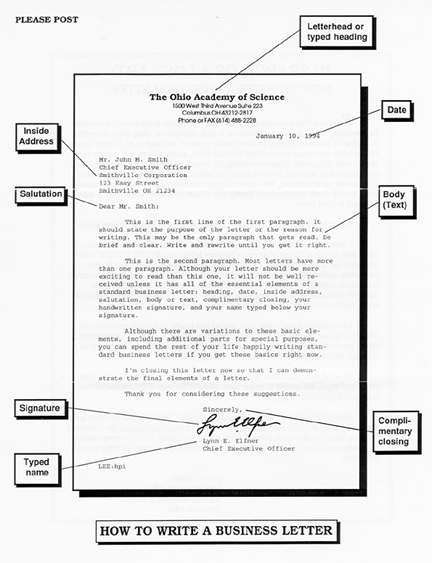
Business letters are very important to communicate formally with a company. Most business letters are printed on letterhead stationary, which includes company’s name, address, and other contact information.

The steps of how to write and compose a business letter are the following:


  • If you do not have a company letterhead, type the complete business address and name of the company. Also you can include your e-mail address and phone number.

  • Leave one line blank followed by the date and always included the complete name of the month. In addition, make sure it is the actual mailing date of the letter.

  • One to ten lines below the date include the recipient’s full name and address.

  • Next leave one blank line. State the salutation or greeting using the person’s formal name such as Dear Mr. or Ms. Last name, and end with a colon.

  • One line below, the body of the letter comes next. It must be single spaced with a blank line between paragraphs. It begin with a general introduction of who you are and the letter purpose. A business letter should be short and directly to the point.

  • After a blank line, you must add a complimentary close such as “Sincerely” or “Cordially”.

  • On the second line sign the letter, and on the next line printed the complete name and job title.
Example

The majority of the companies have a word processing program to create properly formatted business letters. Using the correct business letter format makes your business more professional. Here are some tips you can use to keep your business letter consistent and correct.

-Use consistent margins and spacing. It is recommended 1 to 1 1/2 inches all around.

-The greeting should be addressed to Mr. or Ms. When you do not have a name you may use a polite description such as Dear customer or Dear student. Also you can address the institutions or entity.

-Be meticulous about the grammar and mechanics.

-Use proofreading method it will help to find easier the errors and fix them.

Memo or memorandum is less formal than writing a business letter, is used for internal office correspondence; it may be addressed to an individual or several individuals. It is usually made of three parts introduction, body and conclusion. The memo must be brief, clear and direct to the point; also memos usually don’t include salutation, complementary close or signature. The companies usually have a standard format or template to create it.

Ask these questions before you write a memo:

Why the memo is being written?

What needs to be communicated?

What is the expected outcome to keep in mind?

  • The memo is beginning with a Heading which includes To, From, Date, and Subject with a double-spaced between each.

  • Next on the second line below to the heading is the message which is break into introduction, body and conclusion.

-In the introduction, you should state the purpose or why the memo is being written and what would be the main subject to be explained.

-The body will provide details of the subject such as what is the issue, what are the suggestions and other considerations including options.

-The conclusion will state the recommendations or actions to be done, by whom and when.

  • It should be single spaced with a double spaced between paragraphs or if the memo is extremely short double spaced.


Example


REFERCENCES:

Thill, J, & Curtland, B. (2011). Excellence in business communication. New Yersey: Prentice hall.

http://www.unc.edu/depts/wcweb/handouts/business.html

http://www.writeexpress.com/business-memo.html

PHOTO CREDITS:

http://katherineelizabethvs2010.blogspot.com/2010_05_01_archive.html

http://www.cyberbee.com/science/letpart.html

http://www.pasadenaisd.org/rayburn/Clubs/BPA/contest/businesscorrespondence.html